Technical details about Mahti
Mahti retirement in Fall 2026
Mahti will be decommissioned in stages and replaced by Roihu, CSC's next-generation supercomputer offering enhanced performance and capabilities.
Mahti computing services have been shut down on 31 August 2026. Storage and login nodes are planned to remain accessible until midday 15 October 2026, but users are strongly encouraged to move any required data from the system without delay.
Compute nodes
Mahti had a total of 1404 CPU nodes and 24 GPU nodes. The theoretical peak performance is 7.5 petaflops for the CPU nodes and 2.0 petaflops for the GPU nodes, in total 9.5 petaflops.
Both CPU and GPU nodes had two AMD Rome 7H12 CPUs with 64 cores each, making the total core count about 180 000. The CPUs were based on AMD Zen 2 architecture, supporting the AVX2 vector instruction set, and run at 2.6 GHz base frequency (max boost up to 3.3 GHz). The CPUs support simultaneous multithreading (SMT) where each core can run two hardware threads. When SMT is enabled, the total thread count per node is 256 threads.
The CPU nodes were equipped with 256 GB of memory and the vast majority had no local disks. There were in total 60 nodes that were equipped with a local 3.8 TB NVMe drive.
The GPU nodes were equipped with 512 GB of memory and a local 3.8 TB NVMe drive. They also had four Nvidia Ampere A100 GPUs.
NUMA configuration
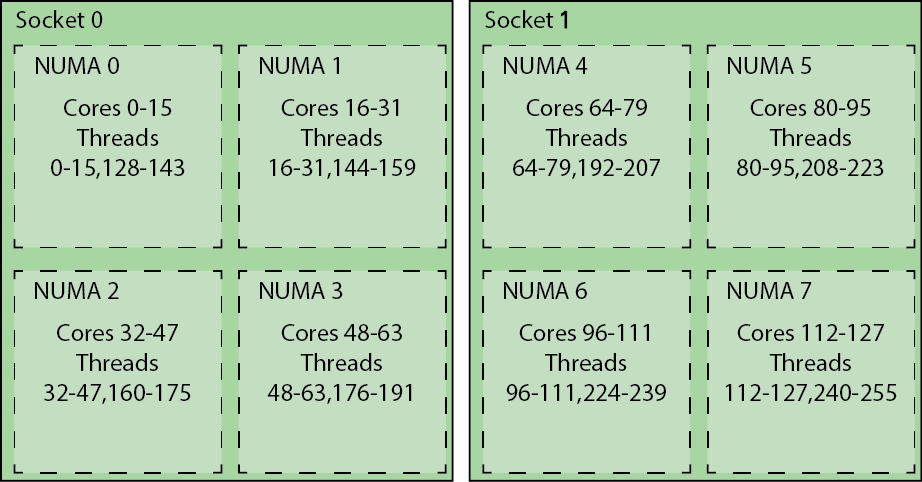
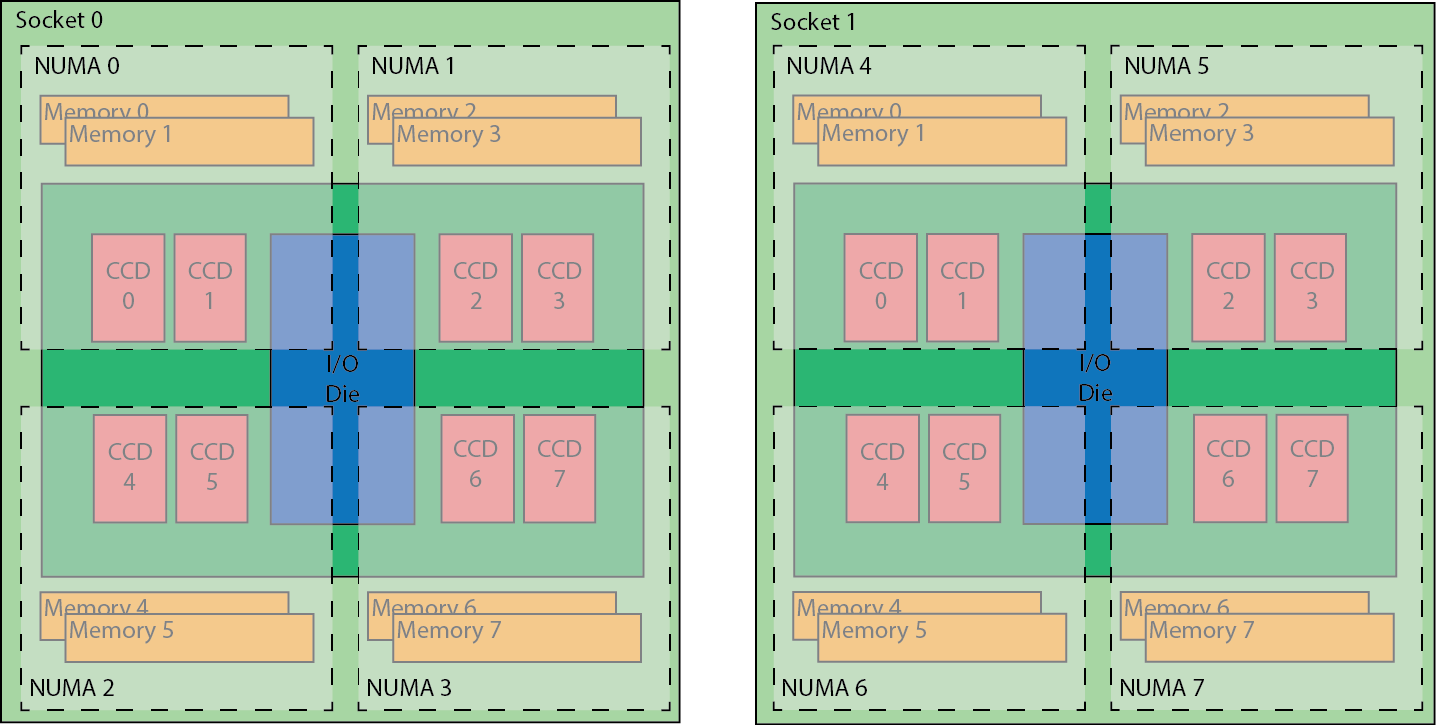
Mahti node had a highly hierarchical structure. There were two sockets in the node, each containing a single CPU and memory DIMMs. All the memory within the node was shared, but memory performance depended on the distance of the core to the memory. In order to provide slightly increased memory performance we ran each CPU in NPS4 (NUMA per socket 4) mode that further split each CPU into 4 NUMA domains. Each NUMA domain had 16 cores, and two memory controllers with 32 GiB of memory in total. Core 0 ran threads 0 and 128, core 1 threads 1 and 129 and so on. The figure below shows how the threads were distributed over each of the cores and NUMA nodes.
Cores, core complexes and compute dies
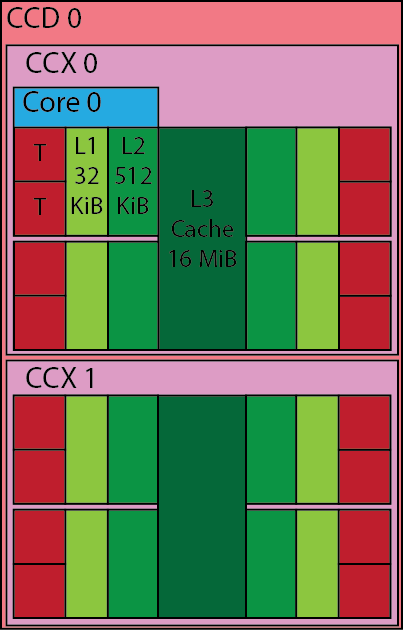
The basic building block of the processor is a core, which are then grouped into core complexes (CCXs), and furthermore into compute dies (CCDs).
Each core has 32 KiB of L1 data cache and 32 KiB of L1 instruction cache, the L2 cache is also private per core and each core has 512 KiB L2 cache. Each core has two FMA (fused multiply add) units, that operate on full 256 bit vectors, meaning operations in 8 single precision floats or 4 double precision floats can be carried out by each unit each clock cycle. Thus, at best 2 (multiply+add) x 2 (two units) x 4 (vector width) = 16 double precision floating point operations per cycle.
Moving up from the core, 4 cores are grouped together into a core complex (CCX), within the CCX the cores share the same 16 MiB of L3 cache. Two of these CCX parts are then combined to form a compute die (CCD).
Each processor consists of 8 compute dies and an additional I/O die that houses the memory controllers and PCI-e controller. Each node is then made up of two of these processors and one 200gbit HDR network adapter.
For an in depth description of the Zen 2 core you can read further on it at WikiChip
Network
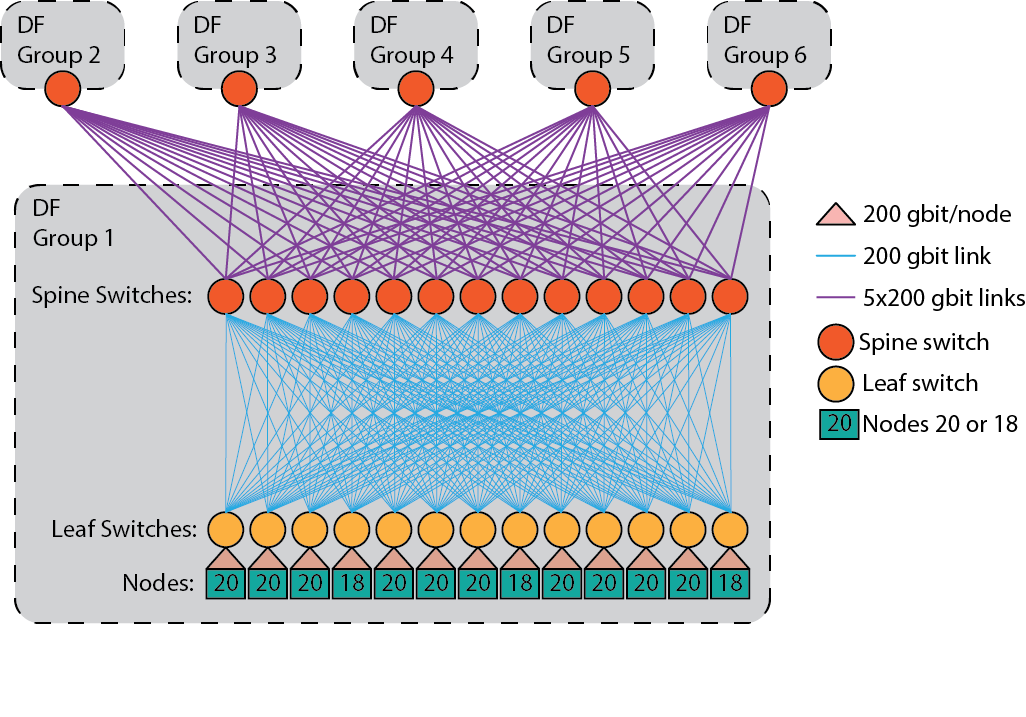
The interconnect is based on Mellanox HDR InfiniBand and each node is connected to the network with a single 200 Gbps HDR link. The network topology is a dragonfly+ topology. The topology consists of multiple groups of nodes, each of which is internally connected with a fat tree topology, these fat trees are then connected to each other using all to all links.
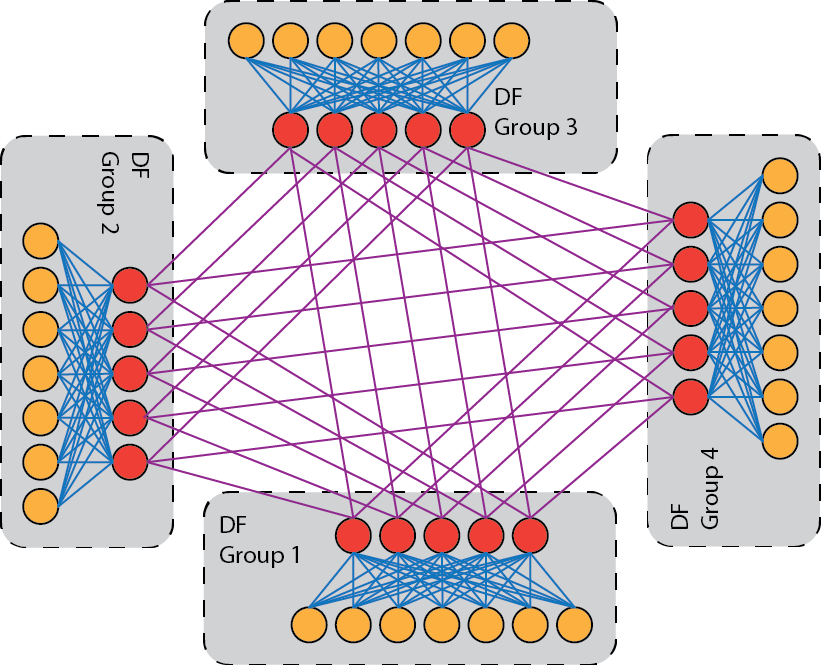
In Mahti there were 234 nodes in each dragonfly group and the internal fat tree had a blocking factor of 1.7:1, with 20 or 18 nodes connected per leaf switch and each leaf switch had 12 links going to the spine switch in the group, all links were 200 Gbps links. There were in total 6 groups, and between the groups there was fully non-blocking all-to-all connectivity, with 5 200 Gbps links going from each spine switch to one spine switch in every other group.
Storage
Mahti has a 8.7 PB Lustre parallel storage system providing space for home, project and scratch storages.
Current Lustre configuration for Mahti is:
| Storage area | # OSTs | # MDTs |
|---|---|---|
| home | 8 | 1 |
| projappl | 8 | 1 |
| scratch | 24 | 2 |
Please see Lustre documentation for the terminology.
The scratch on Mahti can have better performance than the other storage
areas, if your application and the data size is big enough, because of more
OSTs and MDTs.
The peak I/O performance for Mahti is around to 100 GB/sec for write and 115 GB/sec for read. However, this performance was achieved on dedicated system with 64 compute nodes, which means around to 1.5 GB/sec per compute node. If more nodes are used or many jobs do significant I/O, then one does not achieve 1.5 GB/sec. This is also the case if the I/O pattern of the application is not efficient.