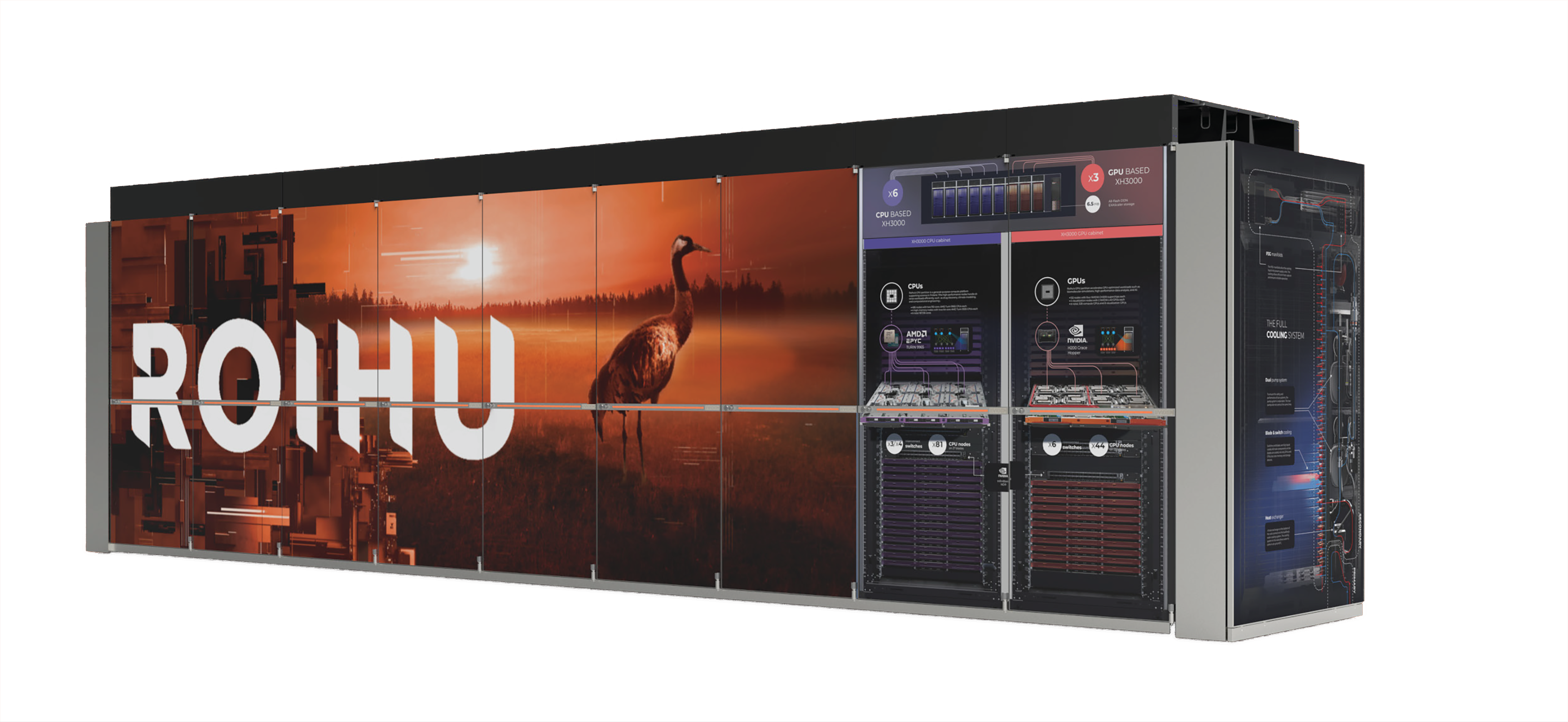
Roihu supercomputer
Note
This page contains preliminary information about CSC's next national supercomputer Roihu, which is projected to be in researchers' use in spring 2026. Please note that the details may evolve over time. See tentative schedule below.
Schedule
graph LR;
    A{{"<b>September 2025</b>
        Roihu installation
        in progress"}} --> B;
    B{{"<b>April 2026</b>
        Pilot phase
        starts"}} --> C;
    C{{"<b>May 2026</b>
        Roihu general
        availability (GA)"}} --> D;
    D{{"<b>One month after Roihu GA</b>
        Puhti <i>computing
        services</i> shut down"}} --> E;
    E{{"<b>August 2026</b>
        Puhti <i>storage
        services</i> shut down"}} --> F;
    F{{"<b>August 2026</b>
        Mahti
        shut down"}}
    style A fill:#dceeceff;
Roihu will be installed in the same datacenter as LUMI, meaning that the system will be brought up without disturbing Puhti and Mahti services. There will also be a margin between Roihu general availability and the decommissioning of Puhti and Mahti to enable users to migrate to Roihu without a break in HPC access.
Puhti will be decommissioned in two steps: First, the computing services of Puhti will be shut down one month after the general availability of Roihu. This means that jobs cannot be submitted on Puhti anymore. Puhti's storage will, however, remain accessible until August 2026, after which Puhti will be retired completely. Mahti will be closed in August 2026.
If you have any data that you need to migrate from Puhti to Roihu, please be prepared to do it during spring 2026, at the very latest in August 2026. CSC will publish a detailed Roihu migration guide in early 2026.
Compute
Roihu will have a total of 486 CPU nodes and 132 GPU nodes. The high-performance LINPACK (HPL) performance is estimated to be 10.5 PFlop/s for the CPU nodes and 23.4 PFlop/s for the GPU nodes, resulting in an aggregate HPL performance of 33.9 PFlop/s for the full system.
The CPU nodes will have two 192-core AMD Turin 9965 CPUs each, amounting to 186 624 CPU cores altogether. The CPUs are based on the AMD Zen 5 architecture, which supports the AVX-512 vector instruction set. 414 of the CPU nodes will have 768 GiB of memory, while the remaining 72 nodes will have an extended memory of 1 536 GiB each.
Each GPU node will be equipped with 4 Nvidia GH200 Grace Hopper superchips. Each GH200 superchip comprises one Hopper (H100) GPU and one Grace CPU with 72 ARM CPU cores which are connected with a very fast interface. Each GH200 superchip has 120 GiB CPU memory and 96 GiB GPU memory, providing a total of 480 GiB CPU memory per node. This gives a total of 528 GPUs and 38 016 CPU cores in the whole GPU partition.
The system will also provide four visualization nodes with two Nvidia L40 GPUs each, as well as four high-memory CPU nodes with 6 TiB memory and higher single-thread performance.
Nodes
| Name | Number of nodes | Compute | Cores | Memory (GiB) | Local disk (TB) |
|---|---|---|---|---|---|
| M | 414 | AMD Turin 9965 | 2 x 192 cores (x86) @ 2.25 GHz | 768 | 0.96 |
| L | 72 | AMD Turin 9965 | 2 x 192 cores (x86) @ 2.25 GHz | 1536 | 0.96 |
| XL | 4 | AMD Turin 9555 | 2 x 64 cores (x86) @ 3.20 GHz | 6144 | 15.36 |
| V | 4 | AMD Turin 9335 Nvidia L40 |
2 x 32 cores (x86) @ 3.40 GHz 2 x GPUs |
384 2 x 48 |
15.36 |
| GPU | 132 | Nvidia GH200 | 4 x 72 cores (ARM) 4 x GPUs |
4 x 120 4 x 96 |
0.96 |
The operating system of Roihu will be Red Hat Enterprise Linux 9 (RHEL9).
Storage
Parallel file system
Roihu will have two independent flash-based DDN EXAScaler Lustre file systems – a 6.0 PiB Scratch space and a 0.5 PiB storage system for project applications and users' personal Home directories. Separate file systems will ensure responsiveness of Home and ProjAppl even under heavy Scratch usage.
The Scratch disk of Roihu will be more than ten times as performant as Puhti Scratch. Specifically, the peak I/O performance of Roihu Scratch is expected to be around 560 GB/s for read and 280 GB/s for write. The Home and ProjAppl will have read and write bandwidths of 120 GB/s and 100 GB/s, respectively.
Similar to Puhti, Roihu Scratch disk will be regularly cleaned of files that have not been accessed in the last 180 days to avoid inactive data accumulating on the system. For longer-term storage and sharing of datasets we will introduce a new disk area called ProjData. ProjData access and quota will be applied for and managed in MyCSC, and the disk area will have its own billing model.
Local storage capacity
Each Roihu CPU and GPU node will have a small 960 GB local disk suitable for storing temporary files during jobs. High-performance local storage will be available on the high-memory and visualization nodes, each of which will include 2 x 7.68 TB fast NVMe disks.
As a new feature, users will also be able to request local disk mounts from a centralized pool of fast storage resources. This fast storage capacity will be provided over the network and will appear as local scratch from within a Slurm job. The total capacity of the disaggregated NVMe resource will be 307.2 TB.
Network
The network of Roihu is based on Infiniband NDR interconnect. Each CPU node will be connected to the network with one 200 Gb/s link, while in the GPU partition there will be four 200 Gb/s links per node, one for each GPU.
Software and programming environment
We intend to provide a comprehensive stack of pre-installed HPC libraries and scientific software on Roihu similar to Puhti and Mahti. Some older and less used software and software versions may, however, be deprecated. Please also note that any software compiled on Puhti and Mahti will most likely need to be recompiled on Roihu. More information will be included in the migration guide.
The programming environment of Roihu will otherwise be similar to Mahti, including e.g.
- GNU compiler stack
- AOCC compiler stack
- CUDA and Nvidia HPC Software Development Kit (SDK)
- OpenMPI as main MPI library
Like Puhti and Mahti, Roihu will also feature a web interface for easy-to-use interactive access and running graphical user interfaces.
More information
- Frequently asked questions
- See the latest Roihu presentation slides (updated 2026-02-25)
- Do you have questions about Roihu or the retirement of Puhti and Mahti? Please contact CSC Service Desk, we're happy to help!